
Fields in Franklin County Property Tax Records
Franklin County property tax records are split across two tools. The Parcel Viewer maps assessment and tax fields, while the Treasurer holds the authoritative current statement and payment answer. Note: Save the assessment year and the date checked whenever you pull a record.
| Field | What It Shows | Where |
|---|---|---|
LastAsmValue | Latest assessment value exposed by the map | Assessor Parcel Viewer |
| Prior-year fields | First through fifth prior assessment-year values | Assessor Parcel Viewer |
HOExemptValue | Homeowner exemption value carried in parcel data | Assessor Parcel Viewer |
CurTxBilled and PrevTxBilled | Current and previous billed fields in the map configuration | Assessor Parcel Viewer |
CurTxOwed, PrvTxOwed, TotTxOwed | Tax-owed fields that require current confirmation | Map lead, Treasurer confirmation |
| Statement and payment status | Current amount, installments, payment, and delinquency | Franklin County Treasurer |
Idaho assesses property at full market value. Exemptions can shrink the taxable amount. A tax bill also folds in budgets and levies, so treat it as neither a sale price nor an appraisal.
Find Franklin County Property Tax Assessment Fields
The Franklin County Parcel Viewer accepts PropStr, StreetName, PIN_1. Owner1 also serves as a search input. Once a parcel comes up, confirm the situs and legal description before digging further. The assessment, exemption, land, improvement, and tax fields then sit side by side. Franklin County publishes no fixed refresh schedule and no stated start date for historic coverage.
| Search control | Tax-record use | Limit to note |
|---|---|---|
PropStr | Starts from a known site | Mailing address is stored separately |
StreetName | Finds several parcels on a road | Partial search, maximum 10 results |
PIN_1 | Links the map record to a Treasurer inquiry | No published formatting guide |
Owner1 | Finds parcels under the primary displayed owner | May not reflect a very recent deed |
Note the value year and the fields you relied on. A bare number without its parcel, date, and source invites misreading.
Confirm a Franklin County Tax Bill Offline
Tax statements are not available online, and the Treasurer page says so plainly. Its payment link helps with payment support. It is not a statement archive or a public delinquent-tax search. Identify the parcel on the map first. Then ask Treasurer Janet Kimpton's office for the current statement or account status.
- Search the Parcel Viewer by address and copy the complete
PIN_1. - Record the map's assessment year, exemption field, billed fields, and any owed fields.
- Contact the Treasurer at 208-852-1095 with the PIN to confirm the live statement and payment status.
- Ask the Assessor at 208-852-1091 about valuation or an exemption shown on the roll.
- Keep the response date because ownership, mortgage, payment, and mailing information can change.
- Assessed value
- The assessor's value before the tax calculation, subject to Idaho's market-value standard.
- Levy
- The rate produced from local taxing-district budget needs and taxable value.
- Homeowner's exemption
- Relief for a qualifying primary residence and up to one acre under state rules.
- Tax lien
- The government's claim arising from unpaid property tax, distinct from the bill itself.
Franklin County Property Tax Due Dates
Franklin County gives property owners two ways to pay. You can settle the full tax bill at once or split it into two equal halves. The first half is due December 20. The second half comes due June 20 of the next year, and the county sends no June statement, so that deadline is yours to track. No grace period applies. No notice means no excuse under Idaho Code §63-902(9). A late second half draws a 2 percent charge plus 1 percent monthly interest from January 1 under Idaho Code §63-903. Those penalties attach to the account itself. If a mapped owed figure looks wrong, confirm the disputed balance with the Treasurer; the official Franklin County Treasurer page posts the local tax schedule and the notice that statements are not online.
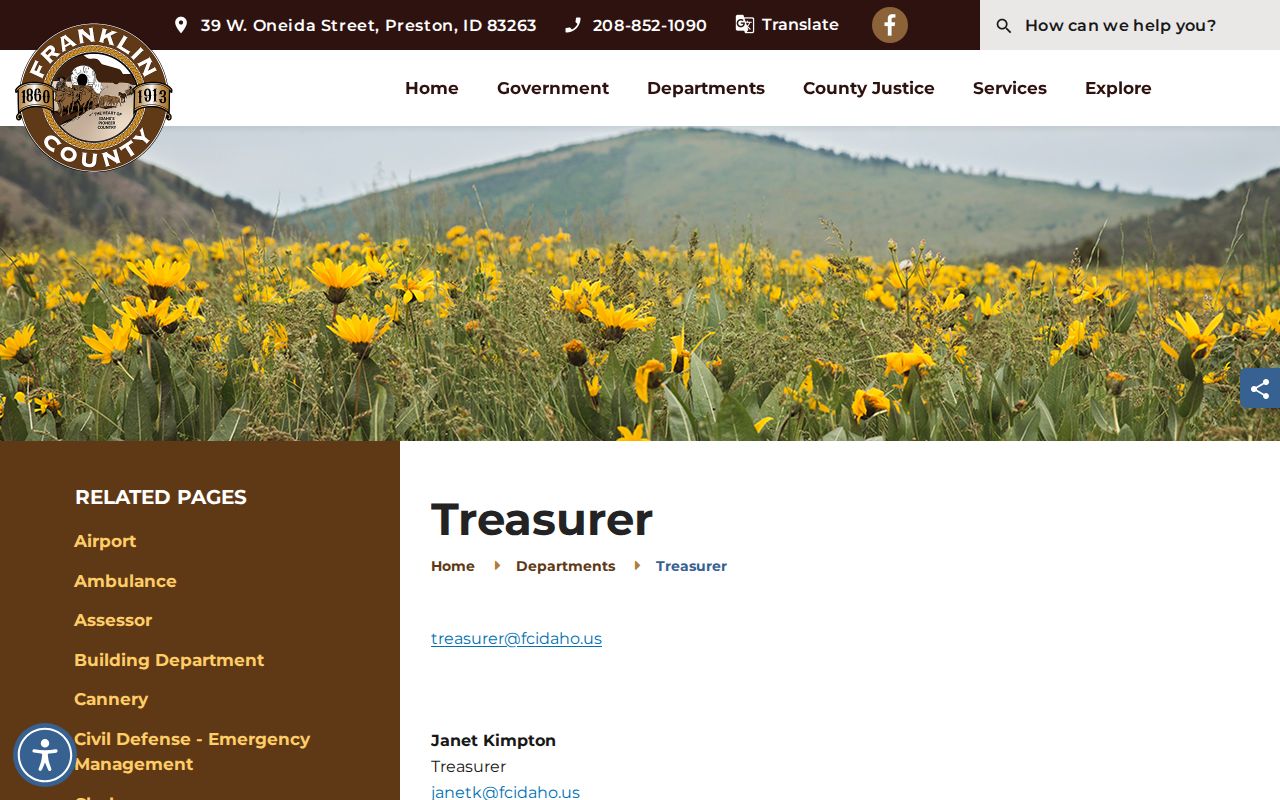
That county source is the working checkpoint for deadlines, payment routes, and current statement access.
Pay Franklin County Property Tax Through the Right Channel
The Treasurer takes cash, checks, bank checks, money orders, and cards at the office. Card payments carry a 2.5 percent convenience fee. Electronic cards cost 2.5 percent as well. An eCheck runs $1. Mail must be postmarked by the twentieth. A drop box sits behind the courthouse, north of the Ambulance Building off 100 West. The office sits at 39 W Oneida in Preston. Hours are 9 a.m. to 5 p.m., Monday through Friday. Verify the parcel number and total before paying. This matters most when a transfer or mortgage change followed the printed November notice.
Homeowner Relief in Franklin County Property Tax Records
Idaho's homeowner's exemption applies to a qualifying primary residence and up to one acre. State guidance describes a 50 percent reduction subject to the current maximum. The Parcel Viewer exposes HOExemptValue, but eligibility and application status belong with the Franklin County Assessor.
The Assessor lists the homeowner's exemption form among its duties. Contact the office at 51 W Oneida in Preston, 208-852-1091, and use the current Idaho Tax Commission homeowner's exemption guidance before relying on an older threshold or form.
Franklin County Property Tax Reduction Window
The property-tax reduction program is often called circuit breaker relief. It opens its filing window each year on January 1. The window closes on April 15. The Treasurer page and state program material mark that period. Income, age, disability, widowhood, veteran, and other eligibility rules can shift from year to year. Use the current state application rather than copying an old figure. Start with the Idaho Tax Commission reduction page. Then file through the Assessor as directed. Relief recorded in one year's Franklin County property tax records never guarantees eligibility the next.
Neighborhood Work Shaped Franklin County Property Tax Values
County commissioner materials from July 28, 2025 report that 2025 valuations were complete. Officials were dividing the county into neighborhoods because land values differ across Franklin County. That local detail explains why a farm, a Preston lot, and land near a city boundary should never be compared by acreage alone. Three dates matter whenever you read a value. One is the year tied to the assessed figure. Another is the date the map was opened. The last is any recorded sale date. Check that the displayed year and fields still stand before quoting a number from the map.
Challenge a Franklin County Property Tax Assessment on Time
Read the assessment notice first. Then call the Franklin County Assessor. Ask what facts support the value on the parcel. Mistakes happen, and a quick conversation sometimes settles the matter before any appeal is needed.
If not, take the dispute to the county Board of Equalization. Idaho law sets a deadline printed right on the notice. For the regular cycle, it is the fourth Monday in June. Special notices can run on a different clock. Follow the dates and instructions on the actual document rather than a general rule of thumb.
Good evidence makes the case. Bring the parcel card, photographs, and sale prices for truly comparable nearby property. Errors in the land or improvement details count too. So does the basis for a claimed exemption. One limit applies. The appeal contests the assessment itself, not the budgets or levy decisions that shape the final bill.
Protect the deadline. Read the date on the Franklin County assessment notice and file with the Board of Equalization as instructed. An informal Assessor conversation does not extend the statutory appeal window.