
Trace Franklin County Former Owners
Work from the instruments themselves, never from assumptions. The table below lists the facts worth capturing for each transfer; it shows the format only, with no sample chain and no invented owners.
| Transfer date | Grantor to grantee | Deed type | Book, page, or instrument |
|---|---|---|---|
| Newest relevant date | Seller to current grantee | As recorded | Copy exact reference |
| Prior date | Earlier seller to later seller | As recorded | Copy exact reference |
| Repeat backward | Prior owner to next owner | As recorded | Keep legal-description match |
The current deed hands you the first prior name. A legal description, not a street label alone, is what proves every row covers the same parcel of land.
Walk Franklin County Deeds Backward
Pull the parcel map fields first: PIN_1, LglAddr, PLATNO, the survey entries, and Deed1 through Deed10. Treat them as leads. The Clerk's recorded book or image settles the question.
- Find the latest deed in which the current owner was grantee.
- Read the grantor and full legal description from that deed.
- Find the deed where that grantor had earlier appeared as grantee.
- Repeat while the land description stays consistent, noting splits, mergers, and easements.
- Grantor
- The party giving the recorded interest.
- Grantee
- The party receiving the interest.
- Chain of title
- The ordered line of transfers affecting the same land.
- Reverse index
- An index organized to find grantees, useful when moving back.
- Quitclaim and warranty
- Different deed forms whose legal effect must be read in the instrument.
Franklin County Clerk Research Gap
The Franklin County Clerk invites visitors to research property information themselves at 39 W Oneida Street in Preston. The county publishes no online land index. Staff will not run broad document searches for callers, especially during election season. A known instrument can be requested by email. Recorded copies run $1 per page. Bring the PIN, the legal text, names, a date range, the document type, and every prior reference you hold. Hours are weekdays, 9 a.m. to 5 p.m.
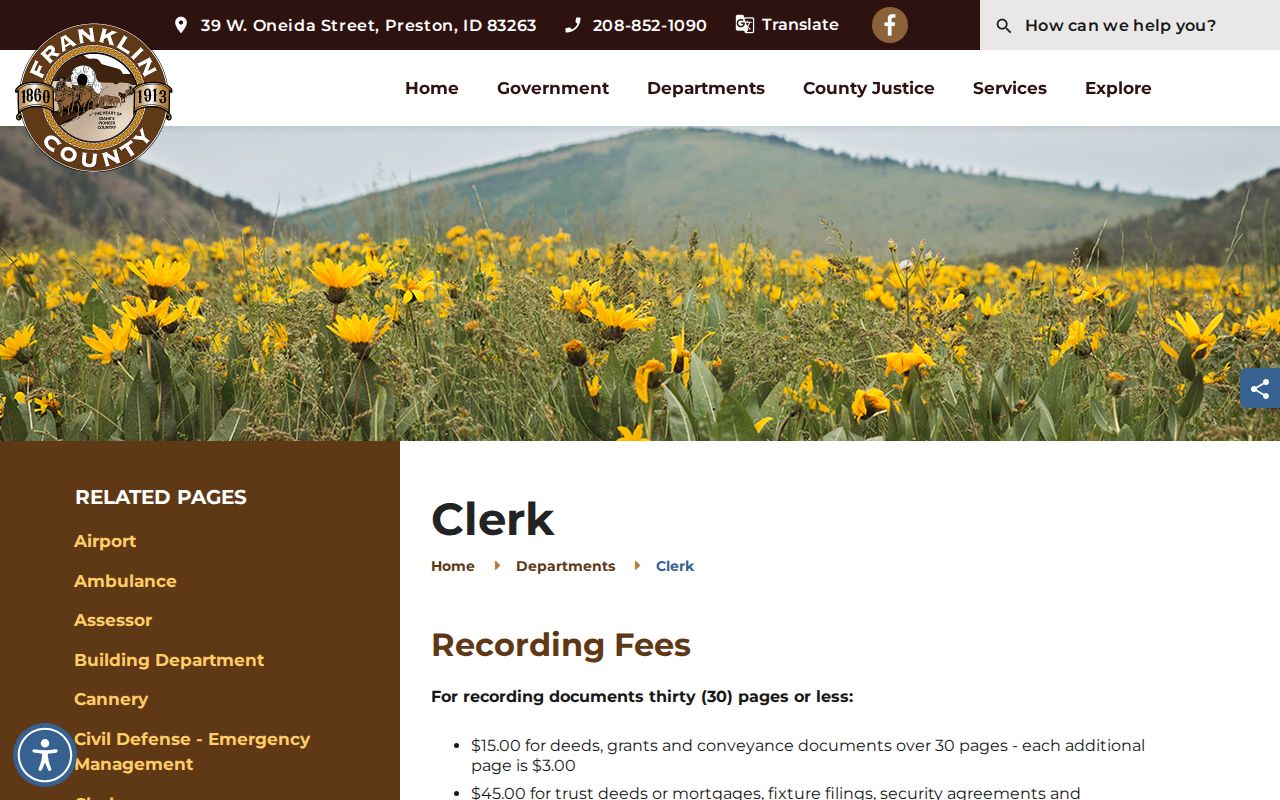
The official page documents the self-service route that replaces an online grantor-grantee search.
Plats Bridge Franklin County Owners
Recorded plats earn their keep when one large tract became several lots or a townsite name replaced a rural description. Carry Survey, Survey_Description, PLATNO, acreage, and lot or block text straight into the deed search. Preston records lean on historic townsite blocks. Rural land uses sections, surveys, and metes and bounds. A plat shows the tract arrangement. It settles no ownership question and names no owner of record by itself. Search deeds for the exact lot shown.
Franklin County Probate Transfers
A clean chain can snap when an owner dies. Search Idaho iCourt for a probate case, and ask the Clerk about a personal representative deed, survivorship deed, trust instrument, affidavit, or recorded court order. A death certificate proves death, not title. Match each probate transfer to the legal description. Estate names can linger on the assessment roll while the court and recording steps grind along. That lag is why record dates matter.
Franklin County Newspaper Bridges
The Franklin County Library digital archive can fill gaps the deed books leave open. A search there often does what the indexes cannot. Probate notices, property-sale announcements, and surname variants frequently surface in its pages. Its title runs include the Franklin County Citizen from 1913 to 1942 and the Preston Citizen from 1962 to 2009. It also holds the Preston News from 1907 to 1912. The Idaho Enterprise run covers 1879 to 1882. The archive reports 50,961 Preston Citizen pages. It even holds a small 1886 justice docket.
Treat OCR results as clues rather than deed evidence. Before you rely on a name, verify the prior owner in the Clerk record.
Old Franklin County Place Names
Former owners often hide behind place names that no longer match the postal address. Search Worm Creek for Preston context. Try Western Settlement or West Town for early Weston. Banida, Coulam, Linrose, Oxford, Treasureton, and Mink Creek can also tie an old notice to present geography.
Preserve initials, spouse names, and estate labels. Repeated pioneer surnames make owner-name-only research risky. The legal description stays in control.
Historic townsite terms matter just as much as geographic ones. The courthouse nomination uses the phrase Tax 20, Block 171, Preston, and Preston history describes sixteen ten-acre blocks laid out when Franklin's early townsite was platted in square blocks. Such phrases help match an old notice or deed to a plat, but they are context, not modern PINs.
Repair Franklin County Chain Breaks
A gap can come from a name change, an estate, a trust, a boundary shift, or an instrument indexed under an unexpected party. Search every grantor and grantee variant. Then compare acreage, plats, surveys, and prior deed references. A mortgage release or easement can mention the same land without transferring ownership.
A split parcel hides a parent tract. One prior deed may cover the whole original holding. Follow the subdivision plat and the later lot deeds forward just far enough to see which new lot holds the subject land. Then resume the backward chain from the parent description. Do not force unlike legal descriptions into one line just because a street or surname matches.
Document Franklin County Prior Owners
Write down every detail the index gives for each former owner. Capture the exact name as spelled, the role played, the deed type, the recording date, and the book and page or instrument number. Add the legal-description excerpt too. Copy or photograph the index page when office rules permit. File that citation with your chain table. A clean audit trail leaves room for later corrections. Broad name searches sometimes come up empty at the Clerk's office. Narrow the request with the parcel PIN and an instrument lead from GIS. The county itself tells users to do their own office research. Ask the staff which physical index, deed book, or predecessor county series to check next. Never assume the chain is finished. Deed labels carry different meanings. A quitclaim, a warranty deed, a personal representative deed, and a trust transfer each move a different interest. Record the type without guessing its legal effect. Note reconveyances, releases, and easements as well. They explain the land history even when they add no former owner.
Franklin County Court Record Bridges
Property litigation can explain a strange transfer. Idaho iCourt may show probate, quiet-title, partition, foreclosure, and easement matters. Searches run by party or by case number. Docket events and orders can point toward a deed or a recorded judgment. Sealed, exempt, juvenile, and protected material stays outside ordinary public access. Remember what a complaint is. It is an allegation, not proof of title. Match any court outcome to the Clerk's recorded lis pendens, judgment, deed, release, or satisfaction. That discipline keeps the former-owner chain honest. Build it on completed public instruments, not on a party name in a lawsuit. With a case number in hand, ask the local court counter. Staff there can explain how to get public copies. Keep court dates and deed recording dates separate. An order may authorize a transfer before the deed is recorded. The chain should show both events only when each one is supported by a record.
Franklin County Ownership Time Depth
Franklin County was organized in 1913. Settlement and land clues reach back before county government existed. The Clerk publishes no online index of earliest deed-book years. No index covers book runs, vault series, or microfilm status either. Do not invent an online cutoff where none exists. Instead, ask which older books and predecessor-county indexes cover your tract. County histories record no courthouse fire or land-book loss. The 1938 to 1939 WPA courthouse story explains the current records setting, not a documented gap. Older searches may reach Oneida County, territorial systems, newspapers, plats, or federal land sources. Where the chain leads determines which.
Coverage limit. No Franklin County online deed start year is published. Continue through in-office books and indexes, and label any unresolved break.
Former-owner research supports house history, estate work, and land diligence. It must never be used to track or harass a living person.